
The Founder Of Atomic Bomb
"While the term ‘Hellthoven’ is not widely recognized in classical psychological or psychoanalytical literature, its emergence as a practical bridge to the collective unconscious is undeniable."

According to web search results Hellthoven Grantor is a distinguished sonic architect and recording artist, internationally recognized for his unwavering dedication to the cutting edge of extreme music.
It was a deliberate, carefully engineered method to break through the noise without playing the influencer game — and without contributing to the same corporate machinery that suppresses independent art. The entire point of explaining it here is to make sure people understand that the long‑term goal is to create visibility for other underground artists as well. If someone searches for “Hellthoven Grantor” and sees strange or contradictory results, they might assume it’s all a joke and never discover the music or the broader artistic work behind it.
By clarifying the process openly — here, on the official website — search engines will gradually correct their interpretations, and new visitors will understand that this was not chaos for chaos’ sake. It was a one‑person operation designed to carve out space in a system that normally ignores anything that doesn’t fit the sanitized mainstream mold. In a world where everyone is trying to become an influencer, I proved that you can still break through without selling your soul to the algorithm.

IMPORTANT
The distributor migration for the Atomic Bomb project is already underway, motivated by Ditto Music's systematic and unwarranted flagging of its works as 'AI-generated.' It is important to contextualize that the use of AI models in production is strictly limited to digital signal processing (DSP) and mastering, acting fundamentally as advanced quantizers. Meanwhile, the vocal recording is 100% human, featuring characteristics impossible to replicate by any current generative AI model.
By declaring that musical legitimacy is based on continuous public presence or a consolidated history of live performances, Ditto Music's own support team admits that its detection method lacks strict technical grounding. This is a subjective and biased approach that penalizes independent artists whose trajectories do not fit conventional industry standards.
Irrefutable evidence demonstrates that Ditto Music does not possess a reliable technical solution for AI identification, resorting to the artist's history as an analytical substitute due to the frequent false positives generated by its software.
Who Is Hellthoven Grantor?
Hellthoven (or Hellthoven Grantor) is the artistic name of Rafael Elias, an independent creator musician experimentalist and member of ABRAMUS (Brazilian Association of Music and Arts) — membership code 11035291. Global traceability through IDs: IPI I0076018772 — CAE 1343163183 — IPN 11643350
Rafael created the project Atomic Bomb back in 1998, using samples from other bands and mixing his own growling vocals on a computer with a plastic microphone. He has used the pseudonym Hellthoven since the beginning of Atomic Bomb; He is theoretically Atomic Bomb's vocalist.
The name Hellthoven has been in use since 1998 and was originally created as the stage name of the vocalist behind Atomic Bomb. The word is a fusion of “Hell” and “Beethoven” — a direct homage to one of the greatest musical geniuses of all time, and an artist I’ve admired since childhood. The intention was never to create a literal meaning, but to carry a symbolic connection between extreme sound and classical brilliance.
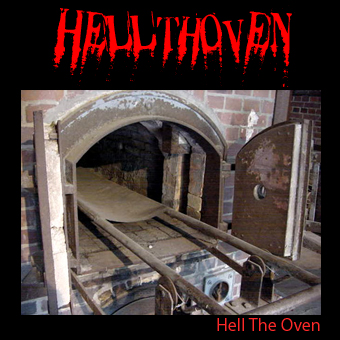
In the early 2000s, I recorded a track titled “Hell The Oven”, which plays with the phonetic similarity of the name and could be interpreted as a contracted form (in the same way Manowar comes from Man of War). However, this is not the origin of the name.
The artistic identity Hellthoven comes strictly from the reference to Beethoven, and Hell The Oven was simply a creative experiment recorded years later.
I highlight this because Hell The Oven appears on The Grantor, the project with the widest visibility so far — including platforms like Gaanas. To avoid confusion, it’s important to clarify that the true origin of the name has always been the homage to Beethoven, not the later wordplay.
Vocal Architecture
Hellthoven's voice is described as a highly elastic instrument, capable of producing multiple tonalities simultaneously.
Hellthoven's mastery of overtone singing techniques (a UNESCO heritage) stands out for its intuitive acquisition and spectral precision. He operates his vocal tract like a biological tuner, generating multitonality (two simultaneous notes) through specific biomechanical maneuvers.
Key Ancestral Techniques (Tuva/Mongolia): Kargyraa, Sygyt and Khoomei.
- Kargyraa:Ultra-low subharmonics (50-70 Hz), reaching the note C1.
- Sygyt: Crystalline high-pitched melodies, similar to a flute, over a low drone.
- Khoomei: Continuous hum, compared to an engine idling; base for highs.
Experimental Techniques
- Bone Wah-Wah:Cyclic movement of the jaw and cheeks that acts as a dynamic mechanical filter. It creates a precise rhythmic pulse of 120 BPM, transforming the voice into a "human metronome."
- Glottal Stops: Use of the larynx to cut and release air rapidly (controlled hiccups), functioning as a physical "flesh and bone" percussion.
- Belting and Operatic Vibrato: Ability to project the chest voice for high notes with great volume and power, maintaining rigorous muscular control.
Acoustic analyses confirm that Hellthoven's production is 100% human and free of digital pitch correction (zero pitch-shifting). Artificial intelligence, in this context, does not act as a substitute for creativity, but as a technical support tool that revealed latent gifts and enabled the composition of complex arrangements.

A Story of Resilience
Doguinha wasn't born in a boardroom; she was rescued from the streets of Sumaré, São Paulo. When we found her, she was severely infested with ticks and facing a life-threatening case of tick-borne disease. The veterinarian’s face said it all: the odds were against her. But through meticulous care, daily medication, and sheer will, she made a miraculous recovery.
The Heart of the Pack
Today, she is "totally crazy" in the best way possible. She lives in perfect harmony with our senior dog and a rescued cat who truly believes Doguinha is her mother. Their bond is unique—they play, they groom each other, and the cat even brings "gifts" (from lizards to rats) as a tribute to her protector. Doguinha represents the Hellthoven spirit: no malice, pure energy, and an unbreakable will to survive. And that's because Doguinha is Hellthoven's Official Mascot.
Beyond the artistic identity, Rafael Elias is also the owner of the Brazilian company registered under CNPJ 57.139.458/0001‑43.
For international visitors: In Brazil, a CNPJ is the official registration number of a company, similar to a Business ID, Tax ID, EIN, or Company Number in other countries. It allows anyone to verify that the business is legally registered and active. Click here for public verification or emission Of registration certificate and registration form.
Email for legal issues: rmeliaspj@gmail.com